


Why “graduating” from retention to a bank guarantee can quietly strangle a growing contractor, and how the security ladder actually works.
Most contractors treat the move from retention to a bank guarantee as a sign they’ve arrived. It feels like the grown-up version of performance security. No more watching 5% disappear off every claim; you hand over an instrument, get paid in full, and look like a serious operator.
Then the term deposit gets locked, the next three projects each demand their own, and the business that was supposed to be growing can’t fund its own mobilisation.
I’m not the broker in our business. My background is actuarial and software: I used to model cash flow for a living, and now I build the tools behind it. My co-founder Mark Coulson has spent more than twenty years arranging performance security, and he kept describing the same expensive mistake to me, so I modelled it. The numbers came out worse than either of us expected.
The mistake is simple. Contractors compare the headline percentage, 5% retention against a 5% guarantee, and assume the cash flow impact is the same. It isn’t, and the gap is worst exactly when a growing contractor can least absorb it.
Here’s the whole ladder.
Stage 1. Retention Is Cash You Never See
Your head contractor withholds a slice of every progress claim, commonly 5% of each invoice, and holds it until the works are done: half released at practical completion, the rest at the end of the defects liability period, usually twelve months later.
The key point for cash flow is that retention is money you never receive in the first place. You don’t have to find it. You just get paid a little less, claim by claim, and the balance builds quietly in someone else’s account. That gradual build is the part everyone forgets when they reach for the next rung.
Stage 2. Cash-Backed Bank Guarantees Carry the Same 5%, But Very Different Cash Flow
When a contractor outgrows retention, or just prefers to be paid 100% of each claim, the usual substitute is a bank guarantee. The bank issues an unconditional undertaking to the head contractor for, say, 5% of the contract value, then takes your cash and locks it in a term deposit for the life of the guarantee.
Same 5%. Same security to the head contractor. Completely different effect on your bank balance.
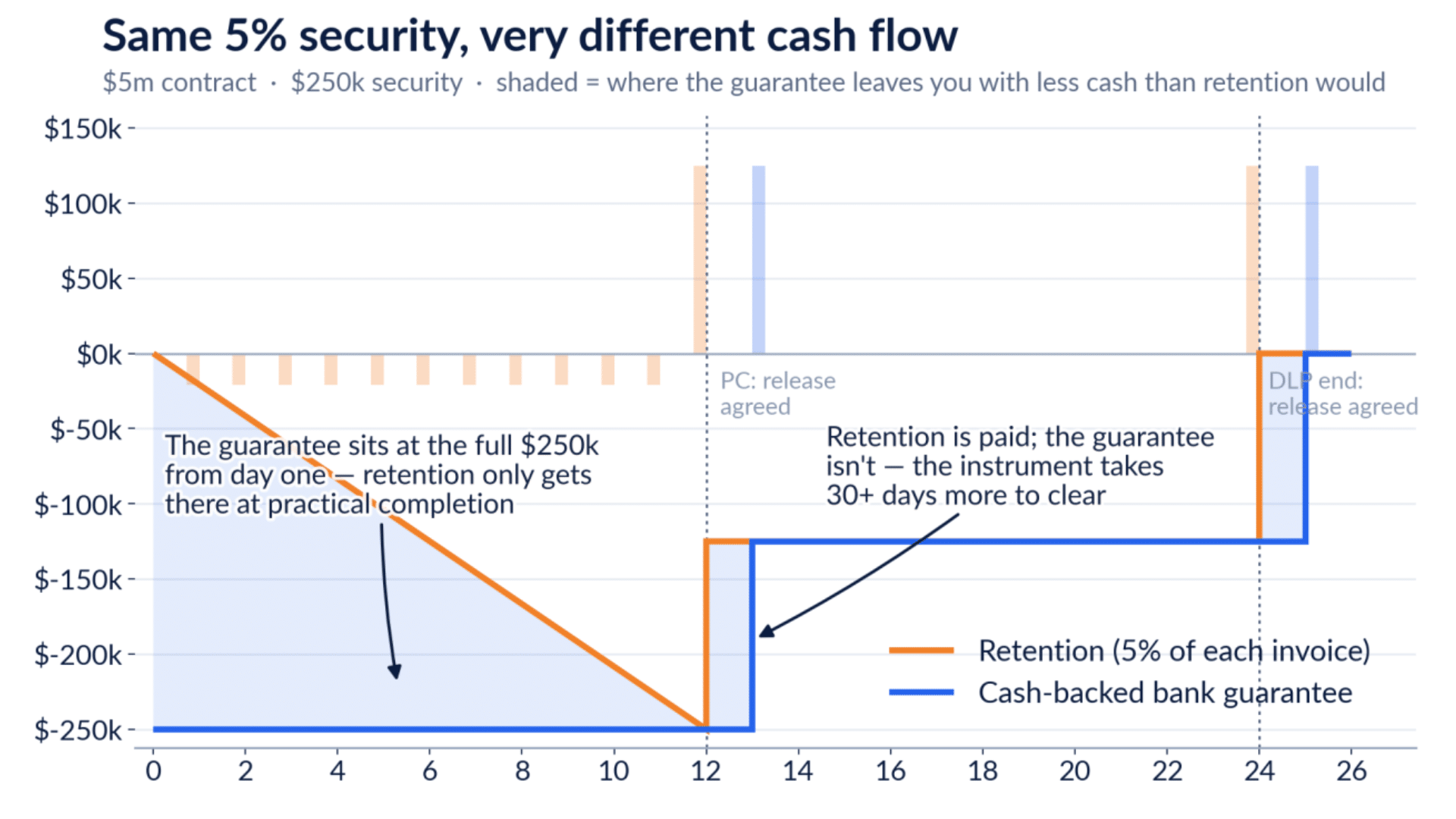
Take a $5m contract, even progress over a 12-month build, so about $416,667 claimed each month. Under retention, 5% of each invoice is withheld, roughly $20,833 a month, reaching $250,000 by practical completion. Under a cash-backed guarantee, you lodge the full $250,000 on day one, before you’ve raised a single claim.
Same 5% security, very different cash flow. On a $5m contract, the guarantee takes the full $250k on day one; retention only gets there at practical completion.
That’s the whole argument in one picture. $229,000 is how much more the guarantee pulls out of your business in the first month alone. By month six it’s still $125,000 heavier, and the two don’t converge until practical completion.
Cash flow comparison of retention vs. a cash-backed bank guarantee on a $5m construction contract
| Retention | Cash-Backed Guarantee | |
|---|---|---|
| Day 1 cash impact | $0 | $250,000 lodged upfront |
| Monthly withholding | Roughly $20,833 a month | None, full amount already locked |
| Total security reached | $250,000 by practical completion | $250,000 from day one |
| Cash gap in month 1 | Baseline | $229,000 more locked than retention |
| Cash gap by month 6 | Baseline | $125,000 more locked than retention |
This illustrative model assumes 5% is withheld evenly across 12 monthly claims, half is released at practical completion, the balance is released after a 12-month defects liability period, and each bank-guarantee release takes an additional 30 days.
A cash-backed guarantee front-loads the hit. You produce real cash, up front, at the moment a project is most cash-hungry, with mobilisation, materials and labour all landing before your first claim is even certified.
It’s also slow to come back. Retention is money, and money moves with a keystroke. A bank guarantee is a physical instrument: it has to be located, handed over, passed to the bank and processed before your cash is freed. In our experience arranging these facilities, that typically adds at least 30 days at every release point. For a contractor running jobs back to back, that tail is where it bites: the cash you’re counting on from the finishing job to fund the next one’s security hasn’t arrived, so you fund both at once.
Measured as cash tied up over time, the guarantee in this example creates approximately 50–60% more working-capital exposure than retention, based on the release assumptions shown. A business doubling its turnover has to double its locked cash at the same time, and that cash has to come from somewhere before any revenue does. It’s how profitable, growing contractors end up cash-starved: not from losing money, from posting security.
“But isn’t retention the worst deal?”
If you have a sharp finance team, they’ll have already objected, and they’re right to. The cash flow story is only half the picture.
Retention has two real disadvantages a guarantee doesn’t.
- It’s someone else’s account: The money you’ve “lost” to cash flow is sitting with your head contractor, and if they fall over before it’s released, you’re an unsecured creditor behind the bank. Depending on the jurisdiction and whether it sits in a statutory retention trust, that exposure ranges from well protected to gone. A cash-backed guarantee is your term deposit, ring-fenced, usually earning interest, and it comes back to you.
- It gets forgotten: The money withheld in dribs and drabs and released across two dates twelve months apart is exactly the balance that slips through the cracks. Plenty of contractors never chase the back half.
So the honest comparison isn’t “retention good, guarantee bad.” Retention is cheaper on cash flow but carries counterparty risk and gets lost; a cash-backed guarantee is brutal on cash flow but ring-fences your money. What you should never do is move from one to the other without pricing the cash flow hit, because there are better rungs above it.
Stage 3. Asset-Backed Guarantees Free the Cash but Encumber the Balance Sheet
Once you have a balance sheet worth securing against, the bank drops the dollar-for-dollar term deposit and issues the guarantee against your broader facility, secured by a mortgage over property or a general security agreement over the business.
No cash leaves the business; the $250,000 stays in your account doing useful work. But it isn’t free. The facility now consumes your secured borrowing capacity, the same headroom you might want for equipment finance or working capital. A cash problem has been swapped for a balance sheet problem. For most growing contractors that’s a good trade, as long as you know it is a trade.
Stage 4. Unsecured Surety Bonds Are the Destination
The top rung is a surety bond facility. A surety, an insurer rather than a bank, issues bonds to your head contractors on the strength of your financials and track record, backed by an indemnity rather than your cash or a charge over your assets. No term deposit, no mortgage, no borrowing capacity consumed. Your bank lines stay free for the things that actually grow the business.
It still isn’t free: based on our experience, a surety typically charges an annual premium in the range of 1% to 3% of the bond value, though the exact rate varies by provider, contractor track record, and market conditions. You’re swapping locked-up capital for a modest ongoing cost, and for a growing contractor that’s almost always the right swap: the freed capital is worth far more in the business than the premium costs. Anyone who tells you surety is “free security” is skipping the invoice.
The Performance Security Ladder, Summarised
A summary of what each rung costs you as you move up the ladder
| Rung | What You Hold | What It Costs You |
|---|---|---|
| Retention | Your cash, withheld by someone else | Exposed to their solvency |
| Cash-backed guarantee | Your cash, locked in a term deposit | Full working capital tied up upfront |
| Asset-backed guarantee | No cash held | Borrowing capacity consumed |
| Unsecured surety | No cash, no security | An ongoing facility premium |
Each rung frees the working capital the one below it held hostage. The contractors who scale cleanly climb deliberately; the ones who struggle jump from retention to a cash-backed guarantee, congratulate themselves on looking professional, and wonder why every new contract makes the bank account tighter.
The Point Most Contractors Miss
Performance security isn’t a compliance checkbox. It’s a financing decision, one of the largest calls on a growing contractor’s working capital, and it’s almost never managed as deliberately as it should be. Two things make the difference: know what you’re holding and what it’s costing you, and climb on purpose. Most contractors track retention and guarantees across spreadsheets, emails and filing cabinets, which is how retention goes unclaimed and guarantees get extended at unnecessary cost. You can’t manage a ladder you can’t see. Here’s how Retention Track shows it to you.
This is the lifecycle Mark and I built our software around: Retention Track for the subcontractors having retention withheld, and bondtrack for the contractors managing bank guarantees and surety bonds on the other side of the same equation. But the tooling is secondary. Treat performance security as a cash flow strategy rather than paperwork, and the ladder stops being a trap and starts being an advantage.
If you’re a growing contractor still lodging cash against every guarantee, the most valuable question you can ask this quarter is a simple one: what would it take to stop?
Frequently Asked Questions
What is a bank guarantee in construction?
A bank guarantee is a bank-issued instrument that replaces cash retention as security on a construction contract, but it isn’t free. Moving from retention to a cash-backed guarantee can lock up more working capital, not less, and the timing of that hit is exactly when a growing contractor can least afford it.
What is the difference between a bank guarantee and cash retention?
Retention is money a head contractor withholds from your invoices, so you never receive it upfront. A bank guarantee lets you get paid in full, but requires locking your own cash in a term deposit immediately, often costing more working capital, faster, than retention ever would.
Is a bank guarantee better than retention?
Neither is universally better. Retention is cheaper on cash flow since you never have to find the money upfront, but it carries counterparty risk and often goes unclaimed. A cash-backed guarantee protects your money in a ring-fenced term deposit but ties up significantly more working capital, faster, than retention does.
How much does a surety bond cost?
Based on industry experience, surety bond premiums typically fall in the range of 1 to 3% of the bond value per year, though the exact rate depends on the provider, your financial track record, and market conditions. This is an ongoing cost rather than a locked-up cash commitment.
What is an asset-backed guarantee?
An asset-backed guarantee is issued against a contractor’s broader lending facility rather than a cash deposit, typically secured by a mortgage or general security agreement. It frees up cash but consumes secured borrowing capacity that could otherwise fund equipment or working capital.
Why do growing contractors run out of cash even when they’re profitable?
Posting security, not losing money, is often the cause. Cash-backed guarantees can lock up significantly more working capital than retention, often around twice as much depending on the contract’s payment schedule and timing, and a business scaling its turnover has to scale its locked cash at the same pace, before the extra revenue arrives to cover it.